
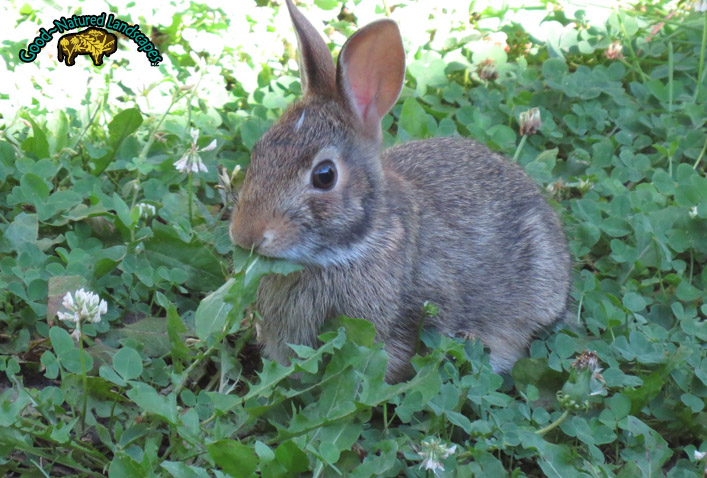
One of the most common questions I receive is “How do I get rid of the rabbits or voles in my yard? If I had an answer or solution, I’d be a millionaire but at the same time I wouldn’t want to remove them because this is their home too! Both are herbivores, so plants are their only food. Rabbits and voles eat plants, bulbs, corms, roots, bark, branches, etc. I’ve lost many plants too so if you’re frustrated, it may be helpful to remember that humans are the reason we have an abundance in our yards – we are responsible for habitat and predator loss, and for other stressors like climate change. Populations also naturally ebb and flow, so some seasons you might have more rabbits or voles than others.
Below are a few tips I use in my garden to prevent some rabbit / vole damage:
- “Liquid Fence” repellant and fencing have worked well for me. Please do not spray repellents on flowers or when pollinators are present. Evenings work best to avoid pollinators. Prevention and monitoring everyday for damage are key so you can take action before you lose too many plants! I use chicken wire fencing for young plants, especially around shrubs during the winter. Enclose the shrubs with at least 3 ‘ tall fencing in winter, and place u-shaped garden staples (landscape staples) along the bottom. Follow the directions for Liquid Fence. There are mint scented repellants but I don’t have any experience with them. If you have a favorite repellent, please share in the comments below. Never use coyote or other wild predator urine repellents since the wild animals are kept inhumanely in small cages for collection.
- Honestly, I haven’t found a deterrent for my voles that I like. My new dog Luna loves to chase and sometimes catches them. She’s getting better with the “leave it” or “drop it” commands.
- Welcome hawks, crows, coyotes, great horned owls, snakes and other predators. Obviously, keep an eye on your dogs if you have coyotes.
- You can try planting rabbit resistant plants, but I found nothing is 100% resistant when they’re hungry. I’ve even tried planting Wild Onion around my Wild Petunia which the rabbits kept eating, but it didn’t work. Finally after a couple of years, the rabbit(s) moved on and my Wild Petunias are flourishing. It also helps to have some plants rabbits or voles prefer in an area outside your garden. I know my rabbits love eating the White Dutch clover and dandelions in my lawn. Voles also like clover.
- Deep mulching also attracts voles and is not good for native ground nesting bees and soil ecosystems. Learn why: Spring Cleanup – Not so fast. Crushed stone might be a better alternative for you garden paths if you have a vole problem.
- Never poison wildlife or use cruel trapping methods like glue traps. Not only are they inhumane, but when we poison or trap voles and rabbits, we end up harming other wildlife beyond the intended target. Poisons impact all animals that may hunt rabbits or voles, including pets. Read more about poisons here: The impact of Rodenticides on Birds Relocating animals is not recommended, it is very stressful for animals but can spread diseases to other populations. In most cases, a permit or license is needed to remove any wildlife from a private property so trapping and disposing of wildlife from your property is illegal.
Love the perspective, your landscape really is wildlife’s buffet! How do you strike a balance between habitat and damage control?
Great question!
Four things that helps me strike a balance is remembering:
1) This is their home too. In fact, we (humans) invaded and converted their natural environment (habitat) to an un-natural environment.
2) Wildlife are sentient beings.
3) All wildlife are in a steep decline right now due mostly to human actions (pesticide, habitat loss & fragmentation, global warming, etc). Just think of the insects and birds you used to see or hear as a child. Big difference. This is backed by science too.
4) We are all connected. We need wildlife to survive!
Of course it depends on the type of damage they are doing. But there is a process called IPM (Integrated Pest Management), in which one of the first steps of the IPM process is identifying the root cause of the problem. After analyzing the root cause, sometimes the fix does not involve harming wildlife. Here’s a simple example, if ants are entering the home and if house cracks are the root cause, the solution might be caulking to prevent them from entering the house, or using a repellent such as peppermint spray to deter the ants. If insects are eating your plants, maybe this plant is food source for them, known as host plant, or maybe this insect is a food source for another insect or bird, so if you eliminate the insect eating your plant, you will disrupt the natural food chain.
I know it’s difficult to strike a balance sometimes, especially when we have been doing things a certain way or when we first see/experience the damage. But I just try to take a step back when I see damage, and remember the 4 things I listed above and the IPM process if I need to take action.